Private Dining Etiquette and Service at Home: A Complete Guide to Hosting with Confidence
Private dining etiquette and service at home has become one of the most discussed topics in hospitality circles, and with good reason: a striking 72% of people now prefer staying in with friends whenever possible, with nearly half saying this shift toward home hosting has happened within just the last few years. Whether you are planning a candlelit dinner for two, a seasonal tasting menu for close friends, or a fully staffed private event with a Private Chef at the table, knowing how to host and serve with grace makes all the difference.
Key Takeaways
| Question | Answer |
|---|---|
| What is private dining etiquette at home? | It is the set of social and service standards that ensure guests feel respected, comfortable, and cared for throughout a meal hosted in a private residence. |
| Do I need a Private Chef to host a private dinner? | Not necessarily, but hiring a professional chef service removes stress from the host and raises the standard of both food and presentation considerably. |
| How many courses is standard for private dining at home? | Three to six courses is typical for a refined home dinner, though the modern trend leans toward four-course tasting menus or relaxed sharing-style feasts. |
| What is the most important etiquette rule for hosts? | Anticipate your guests' needs before they voice them. Attentive, discreet service is the gold standard for private dining at home. |
| How do I manage dietary requirements at a private dinner? | Collect dietary information in advance through your invitation process and design the menu around those constraints, rather than treating them as afterthoughts. |
| Is it acceptable to mix formal and informal service at home? | Yes. The most admired home dining experiences blend polished presentation with warmth and ease, avoiding rigid formality in favour of genuine connection. |
| Where can I find a professional Private Chef for a home dining event? | Blas Dining offers bespoke private chef services across Glasgow, Edinburgh, and Loch Lomond, with fully tailored menus and discreet in-home service. |
What Private Dining Etiquette and Service at Home Really Means
Private dining etiquette and service at home covers far more than knowing which fork to use. It encompasses how you invite, how you prepare your space, how food is presented and served, how guests are made to feel, and how the evening flows from arrival to farewell.
At Blas Dining, founded by private chef Darren Morton whose career spans The Savoy Hotel, private estates, and cooking for royalty, the philosophy is straightforward: great home dining is built on atmosphere, detail, and genuine connection. The food matters deeply, but so does every other element of the evening.
Home hosting is no longer the informal cousin of restaurant dining. Guests arrive with refined expectations, and the best hosts understand that private dining etiquette and service at home now demands the same thoughtfulness you would find in a three-rosette restaurant, delivered with personal warmth rather than professional distance.
Setting the Scene: Preparing Your Space for Private Dining at Home
Before a single dish is plated, the environment does the first and most lasting work. The table, the light, the scent of the room, and the arrangement of seating all communicate care to your guests before they take a single bite.
Here are the foundational steps for preparing your home for a private dining event:
Table setting: Use a clean, pressed tablecloth or quality linen placemats. Lay cutlery in order of use from the outside in, with forks on the left and knives and spoons on the right.
Glassware: Set a water glass and at minimum one wine glass per guest. Polish glasses before service. Spotless glassware signals attention to detail immediately.
Centrepiece: Keep centrepieces low enough that guests can make eye contact across the table. Flowers, candles, or simple seasonal foliage all work well.
Lighting: Candlelight or warm, dimmable lighting creates the right atmosphere. Harsh overhead lighting undermines even the finest food.
Ambient sound: Curate a quiet, understated playlist. Music should be present enough to fill silence but never loud enough to compete with conversation.
Temperature: Ensure the dining room is comfortable for seated guests, remembering that body warmth rises as the evening progresses.
The principle behind all of this is one the team at Blas Dining applies to every in-home event: calm, minimal, and layered with thoughtful detail. Nothing should feel cluttered or rushed.
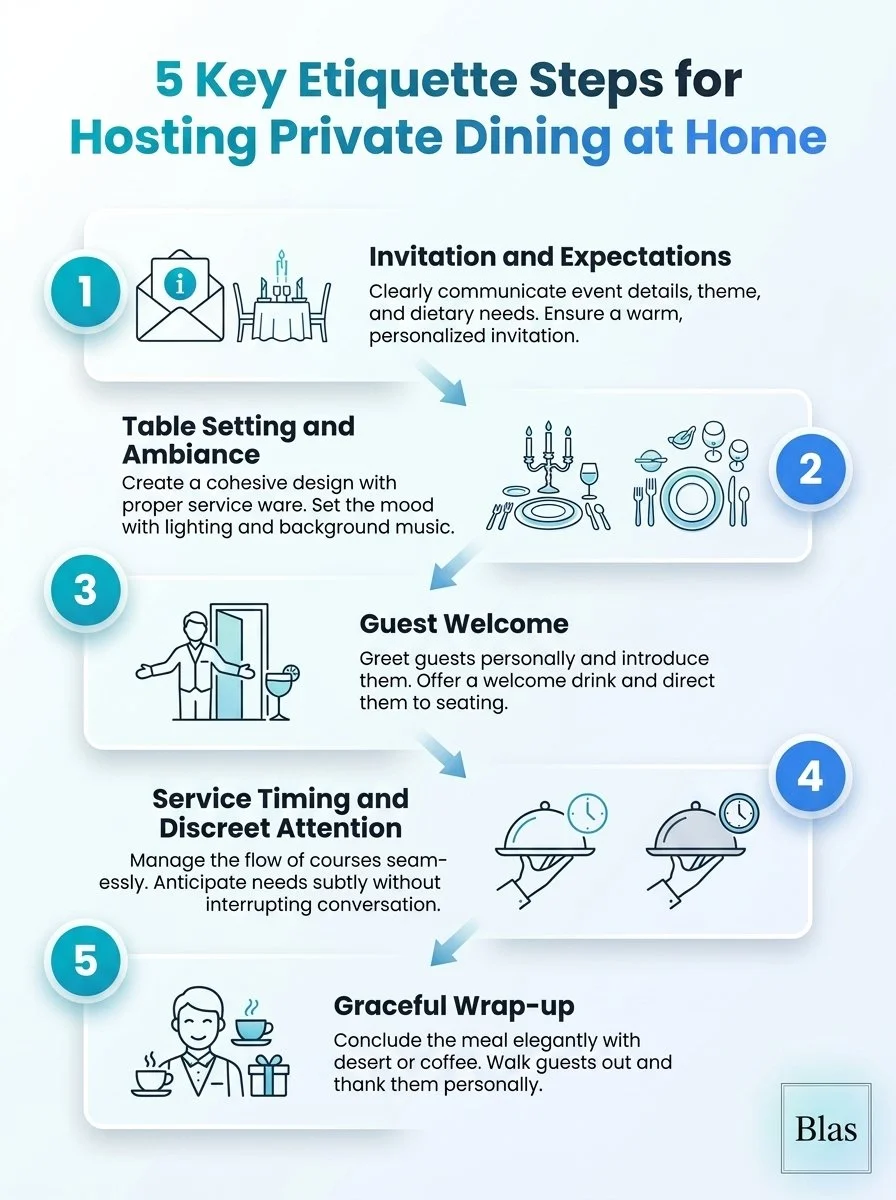
A concise guide to hosting private dining at home. It outlines five essential etiquette steps from invitation to service.
Private Dining Etiquette and Service: The Art of the Table
The service itself is where private dining etiquette at home comes into its own. Whether you are serving yourself or have professional help, the rhythm of how food arrives and how guests are attended to shapes the entire experience.
Consider these core service principles:
Serve from the left, clear from the right. This is the classic convention in formal service, and it allows guests to anticipate movement without feeling interrupted.
Ladies and senior guests first. Begin service with the eldest guest or guest of honour, then move clockwise around the table.
Never reach across guests. Always move around the table rather than across it. Proximity and ease for guests takes precedence.
Pour wine attentively. Keep glasses topped to roughly two-thirds full. Ask, rather than assume, when refreshing glasses.
Clear plates only when all guests have finished. Removing plates while some guests are still eating is one of the most common etiquette missteps at home.
Announce each course briefly. A sentence or two about what is being served, particularly the key ingredients, adds warmth and connects guests to the food without turning it into a lecture.
"Each event is personal. From a small table of friends gathered over scallops and candlelight, to a private tasting menu where every course tells a story of the season, everything is designed with care, restraint, and intention." — Blas Dining
Did You Know?
72% of diners report that having a 'Table Captain', a person who takes charge of the order and logistics, makes the dining experience better.
Source: Resy / American Express
Why Hiring a Private Chef Transforms the Home Dining Experience
One of the most significant decisions a home host can make is whether to bring in a Private Chef. The case for doing so goes well beyond the quality of the food itself.
When a Private Chef is present, the host becomes a guest at their own table. Instead of disappearing into the kitchen between courses, you remain present, conversational, and genuinely part of the evening. This shift in dynamic transforms how the meal feels for everyone at the table.
At Blas Dining, our private chef service in Glasgow is designed with exactly this in mind. From the moment we arrive, everything is taken care of: preparation, service, and clearing away at the end. Every menu is bespoke, drawn from Scotland's finest seasonal produce, whether that is west coast seafood, heritage vegetables, or grass-fed beef.
The practical benefits of hiring a Private Chef for private dining at home include:
Fully tailored menus that account for all dietary requirements and preferences
Restaurant-quality presentation and plating in your own dining room
Professional service timing, so courses arrive with proper pacing
Complete kitchen management, from prep through to clean-down
A seamless experience that lets the host focus entirely on their guests
Research shows that 46% of hosts cite cleaning as their biggest stressor when entertaining at home, with cooking a close second at 34%. A professional chef service addresses both concerns in a single booking.
Menu Planning and Private Dining Service Etiquette at Home
The menu is the backbone of any private dining event at home. Good private dining etiquette and service at home begins at the planning stage, long before guests arrive.
Consider the following when planning your private dining menu:
| Service Style | Best For | Etiquette Consideration |
|---|---|---|
| Plated Tasting Menu | Intimate celebrations, anniversaries, formal dinners | Serve simultaneously; announce each course briefly |
| Sharing Feast | Family gatherings, relaxed friend groups | Pass dishes clockwise; offer serving spoons for each dish |
| Canapé and Course Format | Pre-dinner receptions, larger groups | Serve canapés as guests arrive; transition to table with clear signal |
| Chef's Table Experience | Food-focused guests, special occasions | Allow the chef to introduce each dish; minimise interruptions during courses |
The current trend, reflected in what our guests request across our Edinburgh private dining and Loch Lomond bookings, is a move away from rigid multi-course formats toward menus that feel both elevated and naturally convivial. Four courses with a shared middle section tends to hit the right note for most groups.
Guest Etiquette for Private Dining at Home: What Every Guest Should Know
Private dining etiquette and service at home is not solely the host's responsibility. Guests who understand their role contribute just as much to the quality of the evening.
If you have been invited to a private dinner at someone's home, these principles apply:
Arrive on time, not early. Early arrival disrupts final preparations. If running late, message the host discreetly.
Communicate dietary needs in advance. Raise restrictions at the invitation stage, not on the night. It allows proper menu planning and shows respect for the effort involved.
Stay at the table between courses. Wandering during a formal dinner disrupts the rhythm of service. Step away only between courses if necessary.
Engage with the food. When a host or chef has taken care to source and prepare seasonal ingredients, a comment or question about the dish is always appreciated.
Put phones away. Private dining at home is an intimate setting. Photographing every plate without acknowledgement can feel rude in a setting built on personal connection.
Offer to help sparingly. In a professionally serviced dinner, offering to clear plates can interrupt the flow. Read the room and follow the host's lead.
Invitation Etiquette for Private Dining at Home
Before the evening begins, the invitation sets the tone. Good private dining etiquette and service at home includes communicating clearly and warmly with your guests before they arrive.
A well-crafted invitation for a private dinner should include:
Date, time, and address, with any parking or access notes
The nature of the occasion (celebratory, seasonal dinner, tasting menu)
Dress code, if applicable (smart casual, black tie, or relaxed).
A clear request for dietary requirements and allergies
Whether the event is a surprise for another guest
A gentle RSVP deadline
Digital invitations work perfectly well for informal home dinners. For more formal occasions, a printed or handwritten invitation adds a considered touch that guests notice and remember.
How to Handle Dietary Requirements and Ingredient Sourcing
Dietary awareness is not a niche consideration. It is a central part of private dining etiquette and service at home. Gluten intolerance, plant-based diets, and religious dietary requirements are commonplace, and the most gracious hosts design menus that include every guest from the start rather than offering a last-minute alternative.
A professional Private Chef handles this as standard practice. At Blas Dining, every event begins with a detailed consultation to shape the menu around your guests' needs, never treating a dietary requirement as an inconvenience but as a design parameter.
Beyond dietary restrictions, ingredient sourcing has become a genuine etiquette consideration in its own right. 32% of households now expect or request organic or sustainably sourced ingredients for chef-prepared meals at home. Our approach across all Blas Dining events centres on seasonal, local provenance, from Scotland's west coast seafood to locally grown vegetables and responsibly raised meat.
When hosting privately, sharing brief details about where your food comes from adds both conversation and meaning to the evening. It is the difference between a meal and an experience.
Did You Know?
67% of luxury diners say an 'emotional connection' with the host or service staff improves their overall dining satisfaction more than the price of the meal.
The Modern Approach to Private Dining Etiquette and Service at Home
The rules of home dining service have shifted considerably. The most admired private dining experiences are those that feel warm and personal first, and formally correct second. Rigid adherence to service protocol without genuine warmth leaves guests feeling processed rather than welcomed.
Key shifts in private dining etiquette and service at home that define the current approach:
Sharing dishes are now mainstream. Research shows 94% of diners now prefer share plates or communal service in social group settings. Incorporating a shared course into an otherwise plated menu acknowledges this and adds a natural moment of connection.
Conversation over courses. Longer pauses between courses, designed to allow proper conversation rather than keeping a relentless service pace, are a mark of good hosting.
Immersive elements. 61% of younger guests prefer dining formats that feel interactive or immersive over purely traditional service. This could be as simple as the chef briefly visiting the table to describe a dish, or guests gathering informally in the kitchen for a canapé course.
Warm, discreet service. The goal is to make guests feel attended to without being observed. The best private dining service at home is felt rather than noticed.
This is precisely the philosophy behind Blas Dining's approach to intimate luxury dining: restraint, intention, and atmosphere built around genuine connection rather than performance.
Private Chef Services Across Scotland: What to Expect from a Professional
If you are considering engaging a Private Chef for your home dining event, understanding what the process looks like helps you prepare and ensures the evening runs without friction.
A professional private chef service typically follows this process:
Initial consultation. A conversation to understand the occasion, guest numbers, dietary requirements, and your preferred dining style, from relaxed sharing to fully plated fine dining.
Menu design. A bespoke menu is created around the season and your brief, with ingredients sourced from trusted local suppliers.
Arrival and setup. The chef arrives with all ingredients and equipment, sets up quietly in your kitchen, and prepares everything fresh on the day.
Service. Courses are served at a considered pace, with the chef (or accompanying wait staff) attending to the table throughout.
Kitchen clear-down. The chef leaves your kitchen in the same or better condition than they found it, so the host's evening ends without any clearing work.
Blas Dining offers this full experience across Loch Lomond retreats, Edinburgh townhouses, and Glasgow homes, with each event treated as a distinct occasion built entirely around the people at the table.
To begin planning your private dining experience, get in touch with our team directly.
Mastering Private Dining Etiquette and Service at Home
Private dining etiquette and service at home is not about recreating a restaurant in your living room. It is about creating an experience that feels considered, personal, and rooted in genuine hospitality, qualities that no restaurant can fully replicate.
The foundations are consistent: prepare your space with care, plan your menu around your guests rather than your preferences, serve with attentiveness and warmth, and allow the evening to breathe. Whether you are hosting alone, with a partner, or with the support of a Private Chef, these principles carry the experience from a pleasant dinner to something guests will remember.
The most celebrated private dining experiences at home share one quality above all others: the feeling that every detail was arranged with you, the guest, in mind. That is the highest standard of private dining etiquette and service at home, and it is one that anyone, with the right preparation and approach, can achieve.
If you would like to experience truly professional private dining service at home across Scotland, learn more about Darren Morton's background and Blas Dining's approach, or explore our full range of private chef and intimate dining services.
Frequently Asked Questions
What is the correct etiquette for private dining at home?
Private dining etiquette and service at home covers table setting, service order, pacing between courses, and how hosts and guests interact during the meal. The core principle is anticipating guests' needs discreetly and ensuring everyone at the table feels attended to without the service being intrusive or rushed.
How do I make my home dining experience feel like a restaurant?
Focus on the details that restaurants invest in: polished glassware, proper lighting, timed service between courses, and food presented with care on warmed plates. Hiring a Private Chef removes the logistical burden entirely and brings genuine restaurant-quality preparation and service directly to your home.
Is it worth hiring a Private Chef for a dinner party at home?
For most people, yes. A Private Chef handles all preparation, service, and kitchen clearing, which means the host remains fully present with their guests throughout the evening. The investment pays off in the quality of the experience for everyone at the table, not just in the food itself.
What should guests bring to a private dinner at home?
A bottle of wine, flowers, or a small considered gift is always appropriate, but the most valuable thing a guest can bring is their full attention and good conversation. Communicate any dietary requirements well in advance rather than on the evening, as this is one of the most important etiquette courtesies a guest can offer.
How many courses should a private dinner at home have?
Three to four courses is the standard for a considered home dinner, though a private tasting menu of five or six smaller courses is increasingly popular for special occasions. The most requested format combines a plated starter and main with a shared element, such as a cheese board or dessert arrangement passed around the table.
What are the most common private dining etiquette mistakes hosts make at home?
The most frequent errors are clearing plates before all guests have finished, serving courses too quickly without allowing conversation to develop, neglecting to gather dietary information in advance, and allowing the host to spend so much time in the kitchen that they are absent from their own table. Engaging a Private Chef resolves all of these at once.
How do I plan a private dining menu at home for guests with different dietary needs?
Start by collecting all dietary requirements when you send the invitation, before the menu is designed. Build the menu around those constraints from the beginning rather than adapting an existing menu. A professional Private Chef, particularly one who specialises in private dining at home, will handle this consultation as a natural part of their service and design a menu where every guest's dish feels equally considered.